Pages

Wednesday, October 9, 2013

More Travels 4--Sculpting Memories

Sculpting Memories

Carol took us out mid-morning for a walk down the Horse Trail in Los Alamos. We passed the stables and headed out along the mesa to the overlook at Bayo Canyon. Far below us we could see the hiking trail that led through the canyon. "I think you can drive that," said Carol.
We walk along Horse Trail to admire
Bayo Canyon beneath us.
"It looks like a jeep road," I told her, "and I'm pretty sure that was the second evacuation route from the mesa out of Los Alamos when we had the terrible fires a few years ago," said Carol.
The expansive landscape spreads out
before us when we reach the end of
the Horse Trail.
The mile-long walk out to the Bayo gave us some beautiful views of the landscape below us, and the hot sun warmed us so much that light jackets were uncomfortable.
We stopped for coffee at Ruby K's in Los Alamos and then headed down the mountain.
Our destination was Shidoni Foundry and Galleries and the adjoining Tesuque Glassworks, built in 1975. Shidoni, advertised as one of the greatest resources available for art collectors and sculptors, is located five miles north of Santa Fe in the village of Tesuque.
The gallery and foundry include eight acres of sculpture gardens along the Rio Tesuque on a former apple orchard. We strolled across the grass, avoiding sprinklers and admiring the sculptures.
Swim Buddies, a bronze by Moore,
awaits lifting and delivery outside
the Tesuque Foundry.
Triceratops Skeleton by Brandon Khl
is welded steel and sells for $5,800.
At the foundry, a lift that could raise 4,000 pounds was poised to hoist a new bronze, Swim Buddies about two soldiers at war, but actual pourings of the 2,000-degree molten bronze into ceramic shell molds are only open to public viewing on Saturday Pour Days.
Shidoni, a Navajo greeting to a friend, lives up to its name in every respect. Suddenly, I felt something wet on the back of my left calf. Turning around, I spotted a tiny dog, probably part Chihuahua. It had either nosed or licked my leg.
Andy adopts Moo! by Phillip Glashoff,
a mixed media sculpture priced at $4,900.
“It says NO DOGS ALLOWED here,” said a man’s voice as a golf cart drove by.  He stopped the cart. “No dogs, but this one doesn’t read English.” He chuckled at his own joke. “Enjoy our gardens,” he added, “and let me know if I can help in any way.”
“Shidoni,” I thought. “What an appropriate name for a friendly place.”
I really liked Prickly Pear Cactus by Joe Barrington, a steel sculpture for $8,400, but the price wasn’t right for my pocketbook.
Carol gets a pretend kiss from Brahma by Bruce Newell,
a sculpture made of steel and priced at $15,000.
My favorite pieces inside the gallery were the bronze Indians named Tuli, Daughter of the Pueblo, and Blue Corn by Billy Kratzer and a three-foot bronze of a little tomboy girl with pigtails, who was reaching up to catch a ball in a mitt.  It was titled I Got It! I Got It! By Lawrence Ludtke. Carol and Andy browsed as well, each admiring different pieces and choosing the ones they would most like to purchase.
Andy poses at La Percha de Mi Madre,
a mixed media sculpture for $13,000
by Nicholas Herrera.
At the Tesuque Glassworks, adjoining the Shidoni property, we watched George blow and shape molten glass into a tumbler. We chatted about the Grateful Dead music he played, and Carol learned that she and George shared some mutual friends.
Kay worked the main desk as we talked.  She too knew local teachers from Carol’s school. What a small world! And what a marvelous and creative hobby these artists had found in “retirement.” Before we knew it, the whole afternoon disappeared, and it was time to drive home for dinner.
At the Tesuque Glassworks, George fires molten glass
in the oven to make a tumbler.
Parting is always difficult, but the Dixie Girls restaurant in downtown Los Alamos gave us a chance to share a last meal together. Kurt and Kari joined us after work for a relaxing and delicious dinner.
“At least you don’t have to cook for us again,” Andy told Carol. “I’m getting fed so well here, I certainly don’t want to leave. You had better be careful because maybe I won’t!”

Monday, October 7, 2013

More Travels 4--Red Dots Mark Way

Red Dots Mark the Way

From the top of the canyon,
the Red Dot Trail looks fairly easy.
Today was hike-the-canyon day. Kari picked the trail. The Red Dot Trail led from the canyon ridge in White Rock, New Mexico, down to the Rio Grande River and back up. Kurt led the way down the cliff. We picked our way carefully over huge basalt boulders and crumbled lava, following the switchbacks along the cliff and trying to keep track of the red dots along the way.
We climb over lava and basalt rock on the way down the trail.

Andy comes back looking for us as we
clamber over the rocks and cross the streams. 
Closer to the river the rocks were interspersed with sandy patches. After tip-toeing and rock-hopping across two streams, we made our way to the Rio Grande River.
Kurt and Carol pose by the river.
"This is the bend in the river where we were supposed to get off the water when we tubed," said Kari.
Sue and Andy make it down to
the river, but the worst is ahead.
"They said Red Dot Trail. Hike back up. You'll know the spot when you see a pile of wood that looks like a beaver dam but it isn't a beaver dam. Only I never saw anything that looked like anything." Kari and her friends were picked up miles down the river. Now the Rio Grande rushed past us. Water filled the entire riverbed, and a strong current carried sticks and grass clumps as it tumbled over rocks in little white caps."It's really deep here," said Kurt.
"I was just going to suggest that if we waded across I could say I had crossed the Rio Grande," I told him. "Guess that's not a good idea!"
Kari cools down.
From the bottom, the hike up intimidates.
We all laughed.
We can brag about the accomplishment when we make it to the top.
Then it was time to start the one-hour-and-fifty-minute trek back up the cliff. Concerned about the strenuous climb, Andy even apportioned the water. By the time we reached the top, we were more than ready to make dinner and sip wine.

More Travels 4-Balloons Galore Aloft

Balloons Galore Aloft

As we drive, suddenly the sky in the
distance fills with colorful balloons.
Balloon Fiesta in Albuquerque took off this morning. We knew it at 4:15 a.m. when security alarms went off in the motel. People, tired of waiting for the elevator, apparently used the emergency door. Earlier I had overheard one lady say she had to be at the launch site by 4:30 a.m.
Andy said that weather reports at 7:00 a.m. had balloon launches on hold due to wind conditions. We checked out and headed north out of town on Route I-25. Huge balloons lifted into the air in the distance. By 9:15 a.m. the beautifully colored and patterned inflatables that dotted the sky were already coming down.
We stop in the parking lot at Denny's
to get a better view of the Balloon Fiesta.
Andy explained how it worked. "Rides last an hour to an hour-and-a-half, depending on wind and landing spots," he said, "but it takes three to three-and-a-half hours for the crew to transport the balloon back to Fiesta Park for the next passengers."
A lighthouse is only one of the unusual
shapes we spot from Denny's parking lot.


We were told the whole Balloon Festival lasts ten days, so opportunities to go up in a balloon last all day and all week long.  Drew wanted us to go for a ride. He said it would make for good blog fodder. But at $400 a person, which was the rate mentioned by a young couple we met at the winery, it was a tad out of our price range.
The rolling hills outside of Santa Fe are lined with adobe-style homes. From the by-pass we could see the varied outline of rooftops, all one-story and two-story dwellings. "I can picture the ruins of a pueblo community there," I told Andy. "I wonder what story it will tell hundreds of years hence."
We stopped at Buffalo Thunder casino for coffee around 10:00 a.m.  The car thermometer read 46 degrees, and a cold wind whipped across the parking lot. "This really looks like a giant pueblo," I told Andy. "Can you imagine what the ruins of this place would say about 21st century society!"
Inside a great many of the slot machines played for pennies. "You never saw that years ago," said Andy. "That just goes to show they'll take every last penny."
Heading toward Los Alamos, we notice the green vegetation
as we approach the Jemez Mountains.
It is the result of unusual rainfall amounts this fall.
It was 52 degrees by the time we headed into the Jemez Mountains, but recent rain kept the desert sage green and the Rio Grande flowing.
Los Alamos was located in one of the most out-of-the-way places possible. Back in the 1940's, it must have been really inaccessible. That's apparent by the road in. As we climbed, the temperature dropped again to 46 degrees. In town, the trees had all turned red and yellow.
Andy, Sue, Kurt (back row), Chris, Carol and Kari relax
around the dining room table after dinner.
Carol and Kurt were not exactly waiting for us with baited breath. A half hour before we arrived their kitchen sink sprung a leak under the cabinet and flooded the kitchen. We were just in time to help.
Andy and Kurt set to work on a repair job. Carol and I followed orders for towels, rubber bands and flashlights, but otherwise we stayed out of the way. Progress happens. Before long, Carol had a new faucet, and the kitchen dried out.
Kari's friend Chris joined us for dinner. Kurt had prepared German Gulasch and fried potatoes. He got the recipe from a German cookbook--written in German. Carol had baked apple pie for dessert. It was an evening of good food, good wine and good company.

Friday, October 4, 2013

More Travels 4--Big Government

Big Government Affects Little People 

We got an early start this morning, earlier than usual anyway. It wasn't planned. Construction workers occupied most of the rooms at our motel last night. They went to bed in good time. All was quiet by 10:00 p.m., but one accidentally set off a truck alarm about 5:30 a.m. right outside our window. "I might as well get up," said Andy. "I'm not sleeping any more now."
I grunted and rolled over. Burying my head didn't help either.
A deserted house along Route #117 is stark evidence of the
difficulties of making a living as a farmer in the high desert.
We were on the road by 7:00 a.m., just about the last car to leave the motel parking lot. "It's a good thing," said Andy. "In 14 miles we lose an hour, since Arizona is not on Daylight Savings Time and New Mexico is." By 9:45 a.m.--New Mexico time-- the car thermometer read 45 degrees. Early AND cold! That's not fair!El Malpais warmed 10 degrees as we neared the Cebolleta Mesa along Route #117. "This will be our test case to see what and how much is actually closed down," said Andy. "The main road goes right through the El Malpais National Monument, and much of the land is Bureau of Land Management. There are hikes at pullouts along the road. We'll see what impact the government shutdown has here," he explained. We already knew our hopes of exploring Bandelier and Mesa Verde were in vain.
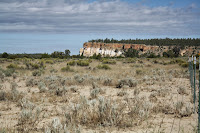
Cebolleta Mesa, part of the El Malpais
Conservation Area, rises in the distance.
It only took another few minutes before all our questions were answered. The turn into Lava Flow Overlook was blocked by a large No Entry sign, and yellow tape fluttered from across the interpretive welcome sign. We lose!
But the South Narrows picnic area was open. "It looks like areas under the auspices of the Bureau of Land Management are still available, like the Narrows Rim Trail from the picnic area," said Andy. The ranger drove past as we pulled out. "I wonder what they would do if we parked and hiked," mused Andy.
Although South Narrows parking area was open, we admire
the scenery and move on, nervous about patrolling rangers.
"They can't ticket you," I told him. "There are no signs prohibiting entrance or parking. Would they tow? That would be terrible. It doesn't say 'Closed' here, so I don't think we could be punished for hiking."
Andy wasn't convinced.
Sun lit the top of the mesa as we drove South Narrows Road through The Narrows. We continued on the winding road through The Narrows.
At La Ventana, The Window, big fuzzy black
caterpillars miss the view as they inch across
the trail in search of richer feeding grounds. 
La Ventana, The Window, offered a half-mile walk to a natural arch in the Zuni sandstone. I read the interpretive sign. This area of twisted tan and white pillars and cliffs started during the Jurassic Period when huge dunes of sand collected and were buried. Dinosaurs stayed near the lush natural oases. Thousands of years later, water seeping into the cracks of the now compressed, hardened and uplifted sand created the formations.
We drove past the entrance to Sandstone Bluffs Overlook. It was closed, and so was the BLM Ranger Station. "It looks like park sites are closed, but overall the BLM sites are open," said Andy. "They just don't have the personnel to shut them all down." We were able to see what was labeled El Malpais National Conservation Area, operated by the BLM, but not areas that were part of the El Malpais National Monument, operated by the National Park Service. Bureaucracy! But at least it wasn't all closed. But our reservations for Mesa Verde would have to change.
minimum speed. Andy chose the right lane.
Named for a natural arch worn in the Zuni
sandstone, The Window allows sun to
stream through at midday.
Driving into Albuquerque today was certainly different from our trip into the city on Route #I-40 three years ago, when a westbound tractor-trailer jack-knifed, causing a 12-mile backup the other direction. Even though the noon-time temperature today was only 61 degrees, the surrounding landscape of sage and grass was green. On our first trip in early 2011, we hit a blizzard out of Gallup and drove some of I-40 in blinding snow. It wasn't a matter of getting off the highway either--even after more than a hundred miles of roadway was closed from Gallup to Flagstaff. That was because none of the New Mexico exits had been plowed. Not so today. Today traffic zipped along toward downtown. In fact, left lane traffic observed a 65 m.p.h. minimum speed.
At the Route 66 Travel Center, gas was $2.999 per gallon. "For that price, I'll fill up the trunk!" said Andy.
In front of the Albuquerque Museum in Old town, an impressive
bronze commemorates Spanish exploration from 1598.
We used our Marianne GPS to find Casa Rondena Winery and then Gruet Winery. Both offered tastings for $7.00 a flight. Our primary interest was picking up a gift or two. As we drove toward Old Town Albuquerque, we found St. Clair Winery, as well. It was advertised as the largest winery in New Mexico. Balloon Festival celebrants were everywhere by this time. Until a couple days ago, we didn't realize that tomorrow would be the start of the annual 10-day festival.
Andy found a place to park on the street near the Albuquerque Museum. That gave us a chance to look at the sculptures there and to walk around Old Town and browse in the blocks of gift shops that line the square. A group of Native Americans played pipes on one street corner, a marimba quartet performed in the gazebo, and a guitarist strummed his instrument across the square.  Tourists jammed the sidewalks. Only the chilly breeze discouraged lingering. And by the time the sun dipped behind the buildings, it was downright cold outside.
Camino Real had thousands of specialty items imported from Mexico, from yard and garden to blankets and wall hangings. "Thirty percent off," said the clerk, "and we want to sell all of it."
But carrying such treasures on the plane home will never work!
We hurried back to the Days Inn and Suites near the airport, our "free" accommodations thanks to Andy's careful tabulation of motel points. "Please help yourself to some soup," greeted the desk clerk. "Warm your innards."
It was spicy Mexican tortilla soup, thick and rich and warm going down. What a special treat!
"We're new owners," explained the manager.
"You've got a great review," I promised.

Thursday, October 3, 2013

More Travels 4-Shutdown!

Government Shutdown Looms Large

Route #87 took us out of the desert to Payson, Arizona. Here and there the trees reminded us it was October, especially the aspen east of Show Low, that fluttered in the brisk morning breeze with dramatic shades of bright yellow. Each time we passed a National Forest Service site--pullout, overlook, campground, viewpoint--we looked to see if it was closed due to the government shutdown that began midnight on Monday--actually 12:01 Tuesday. Andy corrected me. Day trippers had to leave immediately; hotel guests had two days to depart.
A deserted house reminds visitors of the harshness of the
landscape of east central Arizona.


Autumn moves in as we go up in elevation
on the White Mountain Scenic Road.
We crossed the Apache Reservation on Routes #260 and #273. Trees bent in the wind. I shivered when I stepped out of the car for a photo at Sheep's Crossing. Scottsdale had recorded 96 degrees yesterday. It's definitely fall here. At 2:00 p.m. just past Sunrise Park Ski Area in the Lee Valley Recreation Area, the car thermometer read 58 degrees. Huge grasslands spread out on top of the mesa. Cows grazed peacefully, dotting the ridges and meandering along the tree line.
The yellow leaves of aspen trees flutter in the
strong breeze at Big Lake. 
"Nothing's closed here," said Andy, as we pulled into Big Lake picnic area and boat launch. "This is too remote. Not many tourists come here, so unless the government is shut down for weeks, this probably won't be closed." The huge expanses of grasslands interspersed with spreads of Ponderosa pine, blue spruce and Douglas fir, reminded us of South Dakota. "It also reminds me of West Texas," said Andy. "You know, Alpine, Marfa, Marathon... that area."
"But only the grasslands," I agreed.
Big Lake in the Lee Valley Recreation Area
still had visitors, campers, fishermen and hikers.
"We're high here," said Andy, "probably over 7,500 feet in elevation." Brochar Campground still had trailers. Five or six vehicles had parked at the boat launch, and the gate to Apache Trout Campground stood open. One man strolled along the road, another split wood in the campgrounds, boats dotted the lake and a huge American flag fluttered from the boathouse. There were gates here that could be chained and locked, but nothing was barred. "Maybe 'necessary' government workers are spread too thin to close everything," said Andy. "Or maybe this comes under an exemption for self-sustaining areas. And then roads that lead to private homes and ranches have to be accessible, as well."But, regardless of the reason, White Mountain Scenic Road remained open. And that was lucky for us.
About 400 volcanic cones dot the distance from the shelter
at Point of the Mountain Scenic Overlook.
"This IS bear country," said Andy, as we pulled in at Point of the Mountain Scenic Overlook. "You were right about bears, and they have just re-introduced Mexican wolves."
Far below us at 6,985 feet we could see Springerville, Arizona, only 15 miles from the state line of New Mexico. The Little Colorado River wound between the hills beneath us. One interpretive sign said 400 volcanic cones can be identified from the Viewpoint, and it was easy to pick out the lava flow. Fire had destroyed whole slopes of Apache National Forest. Burned trunks of Ponderosa pine lined entire hillsides. But adjoining hills were lush with dark green foliage interspersed with yellow aspen.
"Here's the Little Colorado," said Andy, as we crossed the cattle guard, "and here it's really LTTLE."
Not affected by the government shutdown, Lyman Lake,
a state park for fishermen, is open to campers and vacationers.
The water level of Lyman Lake at Lyman Lake State Park was low. "But this is the driest time of year," said Andy. "It could easily be higher in the spring."  We didn't stay long enough to pay the $7.00 usage fee, but the couple of pictures were pretty with the late afternoon sun reflecting off the water.
Far out in the country, between Springerville and Lyman Lake was a huge complex of buildings, surrounded by lights. The sign read ASPC Apache Unit I. "So that's why Springerville exists," said Andy. "It's a prison--Arizona State Prison Commission."
Strong winds churn up the water of Becker Lake
outside of Springerville, Arizona.
That and the lumber yard and the power plant give Springerville three reasons for being... way out here in the middle of nowhere.
A mile in on a dirt road, the 357-acre Wenima Wildlife Refuge protects a small native endangered freshwater fish called the Little Colorado spinedace. We read the dedication sign and started up one trail but then thought better of it. Thick grasses flattened by a tractor could easily be home to snakes, and here in the valley with the sun going down, it was still 70 degrees.
The Historical Park in Springerville displays this windowless
box, Clay Hunter's home for 60 years.
Becker Lake Wildlife Area was set aside by the Arizona Game and Fish Department for catch-and-release trout anglers. A brisk wind whipped up the water, so the 70-degree temperatures felt colder than that. We walked part of the trail that skirted one side of the lake as anglers pulled off their rubber wading pants. It was already 5 p.m.... time to head "home" for the night.
Andy rings the dinner
bell before we head out for
Mexican cuisine.
But before we actually headed "home" for the night, we followed the signs to the White Mountains Historical Park. Here buildings as old as the 1890's were preserved to honor the town's colonial heritage. They even had the 1919 Ranger Station from the National Forest Service. But the most unique and unusual display was the windowless trailer box 1890 home of Clay Hunter. A hunter and trapper from this area, he lived in this box for more than 60 years. I'd have claustrophobia!

More Travels 4--Scottsdale Blooms

Bird of Paradise

Scottsdale Blooms

with Fall Color

Sand Verbena


Three days in Scottsdale spoiled us totally--luxurious accommodations, golf course strolls, hot daytime temperatures, three delicious meals a day, exotic desert surroundings, magnificent night skies, and most of all, wonderful company. A marvelous and generous hostess, Shannon treated us like royalty. Our Connecticut best friend made it oh so hard to leave Scottsdale!
Andy, Sue and Shannon sample Happy Hour at the
Rare Earth Pizza and Wine Bar in Scottsdale, located between
Troon Mountain and Pinnacle Peak.
Prickly Pear cactus

Shannon, Andy and Sue say goodbye.

Tuesday, October 1, 2013

More Travels 4--Scottsdale Cools Off

Scottsdale Cools Off

As Andy drove toward Phoenix this morning, I read the Echoes newspaper to him. This park news and visitor guide covered a wide variety of topics relating to the Verde Valley. Most interesting to me was the change in attitude about what became of the ancestral Puebloan and Sinagua peoples. Years ago, when Andy and I toured these areas, we were told that the pre-historic people who lived here and thrived just vanished around 1300. In the newspaper Ranger Case wrote, "...the people who lived here simply moved.
In the afternoon, shadows darkened the ridges of the
Continental range of northern Scottsdale.
Archaeologists are still trying to understand the details, but we do know that population centers began to shift. But the people did not disappear. The descendants of Montezuma Castle and the Verde Valley still live nearby today."

Saguaros dominate the
Scottsdale landscape.
                    I guess the word is assimilation. They moved on and were assimilated into surrounding populations. Perhaps they left the Verde Valley because the land didn't produce as it had in the past or they moved on because disease infected the population of people living in close quarters. No matter what the actual reason, it was time for change.And that's no different from today when a society looks for advancement and progress.
Maybe that's why 220,000 people today volunteered to go on a one-way trip to Mars."Starting now is the best time of year to be in Scottsdale," said Shannon's neighbor when we arrived in town at the home of a close friend.As the sun dipped down behind the Continentals, and the top of the mountain ridge glowed, I had to agree. Temperatures cooled into the 70's. It was a beautiful Arizona evening.